
Merl, a district in full mutation
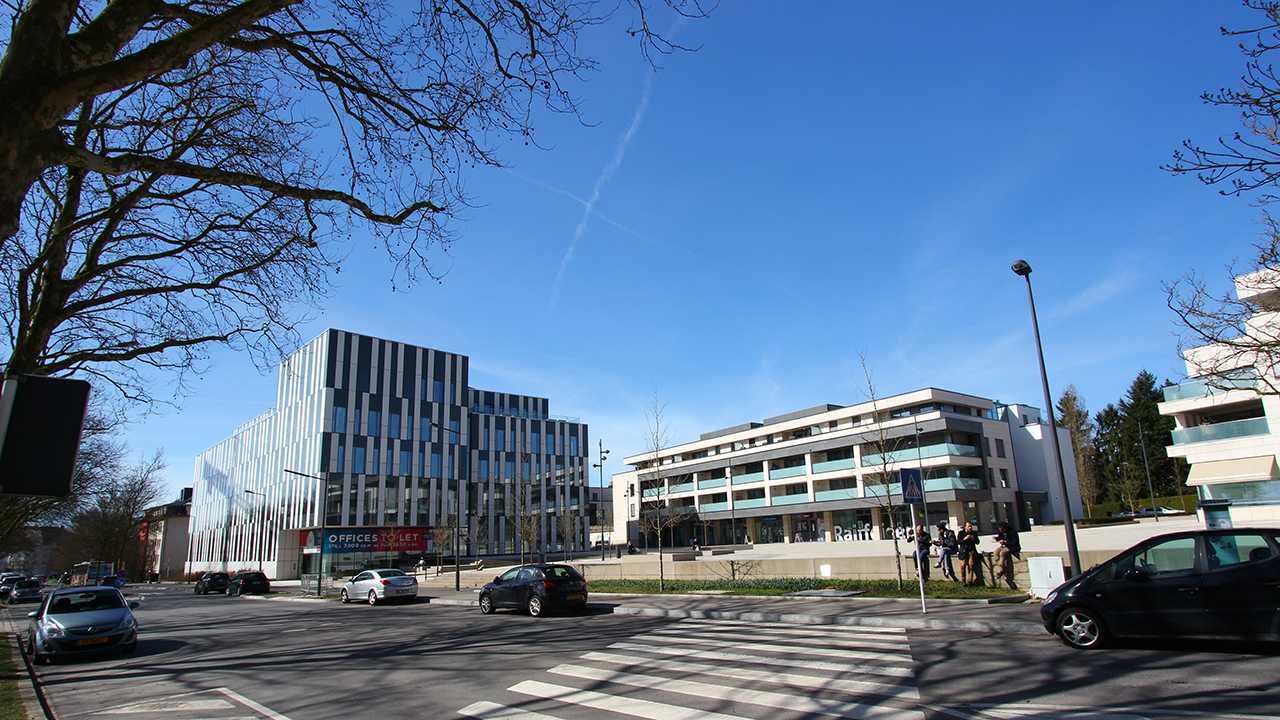
Just a stone's throw from the city centre of Luxembourg, the Merl district has a lot to offer. Thanks to its green spaces, its park and its many ongoing projects, the district attracts an increasingly cosmopolitan population.
In Luxembourg, surrounded by the districts of Belair to the north-east, Hollerich to the south-east and the municipality of Strassen to the west, Merl can count on an ideal geographical location.
Accelerating growth
A friendly neighbourhood with a village character, Merl has no less than 5,381 inhabitants (figures as at 31/12/2016) in its 2.43 km2This is about 4.7% of the capital's population. Although its growth is usually stable (between 100 and 250 new residents each year), in 2016 the district saw a clear increase in its inhabitants (+412) compared to previous years. This growth is gradually increasing the population density of the district.
The population has not only increased but also diversified. The district is characterised by its multiculturalism: 73% of its residents do not have Luxembourg nationality. In this small area, there are almost 100 nationalities, including French, Portuguese, Italian, Belgian, German, Spanish and British. Because of its strategic location, Merl is attracting more and more young couples and single people who want to live in a quiet area just a few minutes from their work. The housing is of high quality. This results in relatively high property prices.
Infrastructure for all needs
This does not necessarily deter young households, who choose the Merl district because of its varied infrastructure. Merl is home to several schools. The Merl school, which has several buildings, was recently extended to provide better facilities for younger children. Nearby secondary schools, such as the Lycée Michel Rodange and the Athénée de Luxembourg, cater for teenagers. A number of local shops (such as Cactus) add to the attractiveness of the neighbourhood.

Sport and culture in the spotlight
Sports enthusiasts will also find plenty to do in Merl. The Stade Prince Jean, which houses the Merl-Belair football pitch, has been completely refurbished due to the state of its infrastructure. The district also has a gymnasium, a sports hall, a polo field and the Pétrusse stable.
To complete its range of services, Merl can count on the Conservatoire de la Ville de Luxembourg. A real asset to the district and a cultural ambassador for the City, the Conservatory has benefited since January 2016 from a new extension, made necessary by an ever-increasing demand for teaching. New rooms for music (percussion, saxophone/jazz), theatre and dance have been added to the infrastructure. A cultural centre, "Home Saint Genoul", also offers a number of events for a wide audience.
Green spaces for relaxation
When it comes to leisure and recreation, Merl is not to be outdone. There are numerous outdoor areas and green spaces for young and old alike. There are public playgrounds, multi-sports fields for ball players, a recreation area near the cemetery and a park where you can relax or play trampoline in summer. The stream, which runs through the neighbourhood from west to east, further reinforces the village character of the area.
What are the property prices at the moment?
Sometimes complicated mobility
In Merl, every effort is made to promote alternative forms of mobility. There are seven car parks and four Vel'oh! stations. Several bus lines frequently serve the ten or so bus stops in the district. The nearby Bouillon P+R is intended to relieve traffic to and from the city centre. Despite these measures, Merl suffers from daily traffic jams. The district is crossed by several major roads used every day by local residents and workers in the capital.
Projects to revitalise the neighbourhood
In an ongoing effort to improve its infrastructure and to accommodate its growing population, Merl has initiated several projects. A special development project (PAP) for a new district called "Centre de Merl" has been launched. The project provides for the creation of housing of various sizes and types on an area of approximately 330 ares. 42 single-family houses and nine apartment blocks, comprising 142 dwellings, are to be built. The project is a response to the shortage of housing in the area and in the country as a whole.

The "Jardins de Luxembourg" project plans to create a total of approximately 76,000m2 of building space, including approximately 2,000m2 of commercial space and 640 homes. In Merl, five apartment buildings with 100 dwellings will be built on a surface area of 90 ares.
The green spaces that are a joy for the residents of Merl will also be given a facelift. The renovation of the Merl park pavilion will be completed by autumn 2017. The terrace and restaurant will be extended, an annex will be created and the rotunda will be refurbished.
Merl aims to be environmentally friendly. For this reason, a storm water basin will be built and mixed water and waste water collectors will be installed to clean up the district and provide it with adequate water capacity. To the north, a new recycling centre as well as buildings and infrastructure for the city's hygiene and cemetery services will be built.

Written by
Fanny Pimentel
Posted on
03 July 2017